

Inspired/horrified by Strange New Worlds S4E5, “A Level 5 Transporter Accident,” I couldn’t resist creating the following scale, which assumes that turning the entire crew into puppets rates a Level 5.
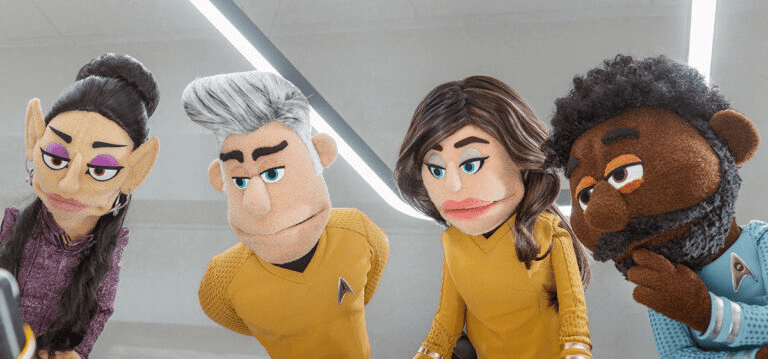
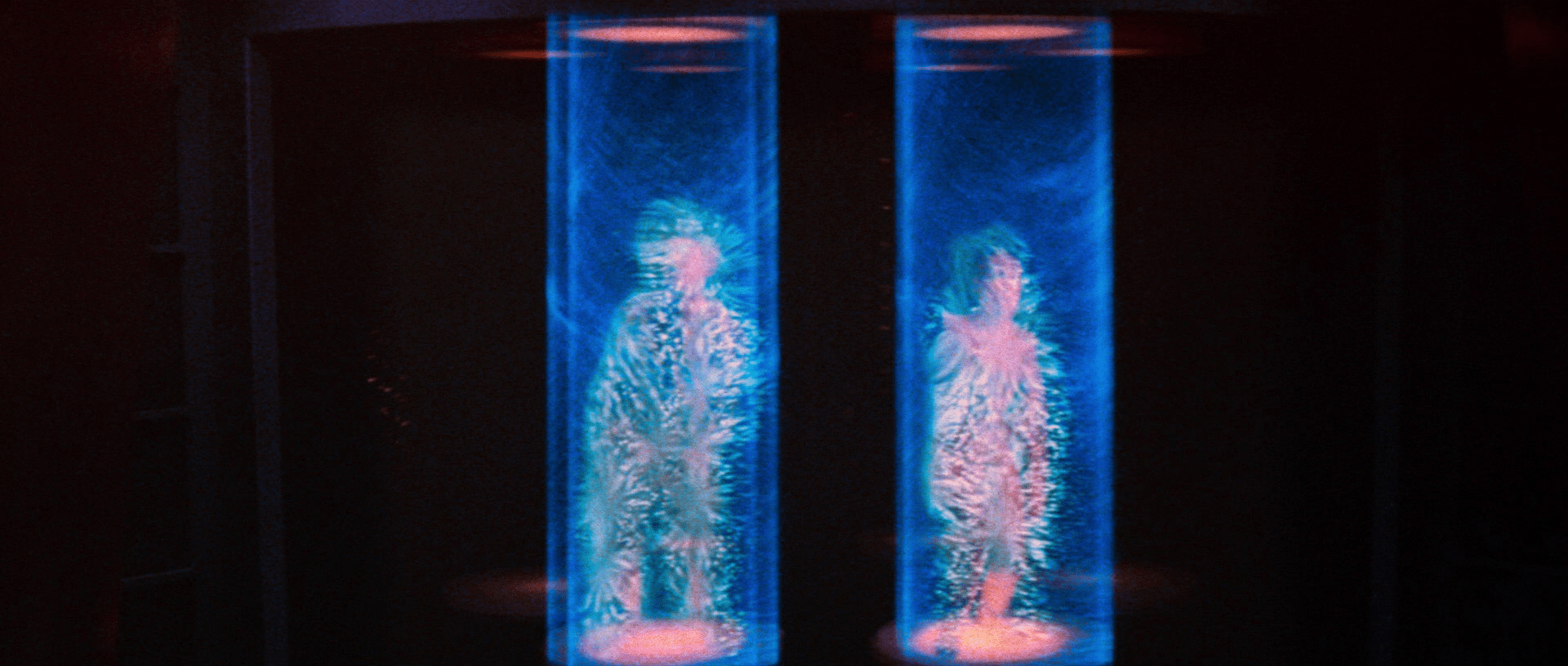
I have to admit, regardless of the quality of the episode, the Pelia puppet was probably worth the effort:

Working backward from Level 5, here’s a proposed full scale, with every incident in the franchise graded against it.
(Credit where credit is due: This list was assembled with the assistance of Claude Fable 5. I remember most of these episodes, but some of them I’ve blocked from my memory, like anything having to do with Star Trek: Picard.)
The Scale
| Level | Definition |
|---|---|
| 1 | Glitch, no biological effect (delays, sparkles, mild chroniton flux) |
| 2 | Cosmetic or annoying effects, self-resolving |
| 3 | Psychological trauma or temporary entrapment; full recovery |
| 4 | Significant transformation or displacement, reversed with effort |
| 5 | Alteration of personhood: duplication, merging, splitting, puppets |
| 6 | Serious physical injury |
| 7 | Reality/universe breach |
| 8 | Fatality (single) |
| 9 | Multiple fatalities |
| 10 | Multiple fatalities, horrific |
The Catalog
Turns out that’s probably only level 2, or level 1 if Kirk actually did it intentionally but just blamed the transporter (and ordered the chief to shut up about it).
Level 2 — Annoying but harmless
- “Much Ado About Boimler” (Lower Decks, S1E9) — Boimler comes out of a transporter mishap phased, translucent, and emitting a constant hum. Shipped off to “The Farm” with Starfleet’s other medical oddities. Fully recovers. Dignity does not.
Level 3 — Trauma, full recovery
- “Realm of Fear” (TNG, S6E2) — Barclay sees worm-like creatures in the matter stream and becomes the poster child for transporter phobia. The “microbes” turn out to be crew members trapped in the pattern buffer, and Barclay’s neurosis saves them all. The rare accident where the anxious guy was right.
Level 4 — Serious, reversible
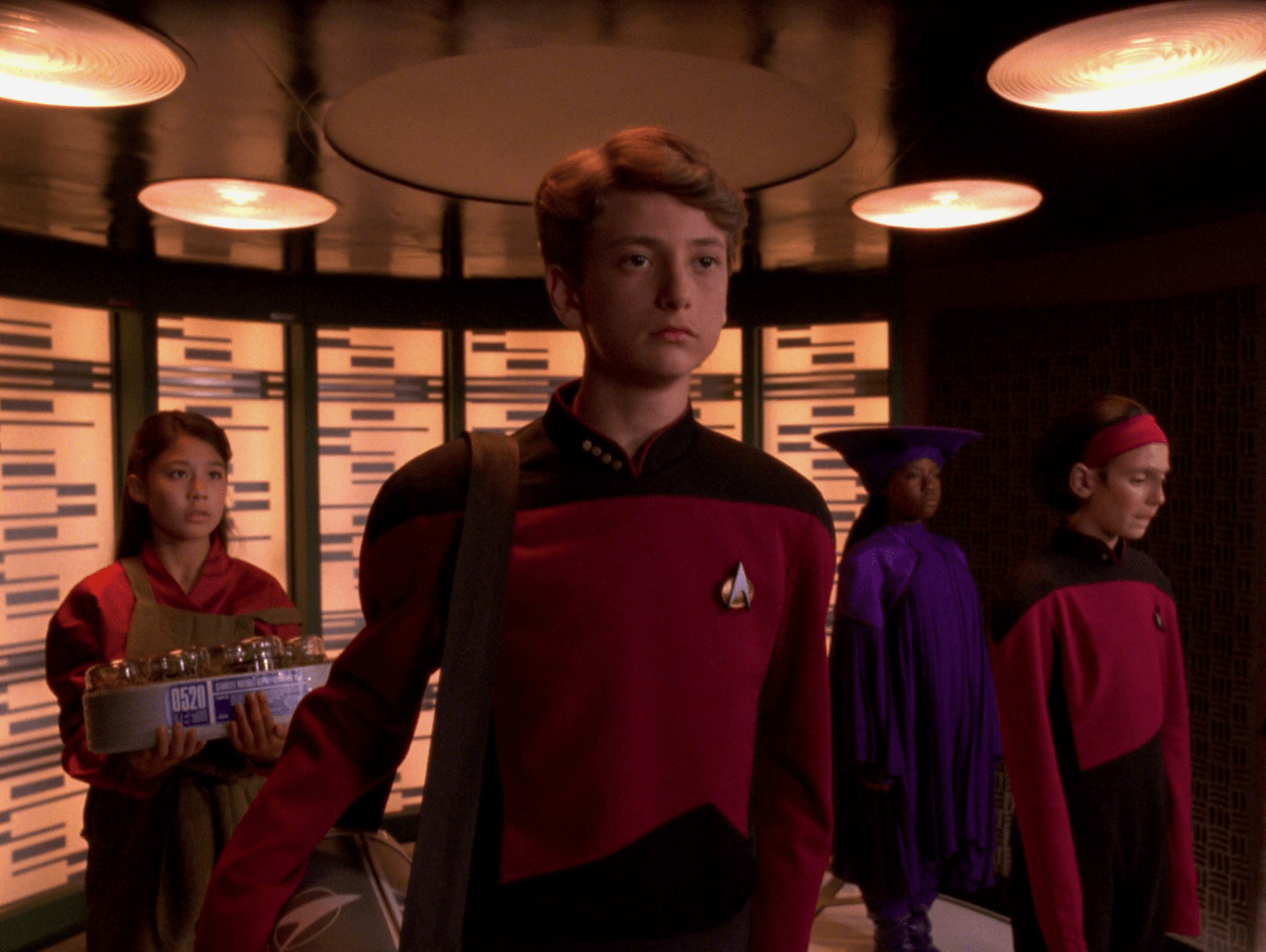
- “Rascals” (TNG, S6E7) — Picard, Guinan, Ro, and Keiko rematerialize as twelve-year-olds. Reversed by the episode’s end, though not before Captain Picard has to pretend Riker is his dad.
- “Past Tense” (DS9, S3E11–12) — A chroniton surge hurls Sisko, Bashir, and Dax to San Francisco, 2024. Technically a transporter accident, functionally a time-travel two-parter.
- “Our Man Bashir” (DS9, S4E10) — Five crew patterns get dumped into a running holosuite program, and Bashir must keep his James Bond fantasy going or his friends’ physical patterns are erased. The only transporter accident resolved by seduction and baccarat.
- “Mindwalk” (Prodigy, S1E17) — Dal and Vice Admiral Janeway swap consciousnesses across light-years via transporter. Reversed, but not before some quality body-swap comedy.
Level 5 — Personhood violations (the canonical benchmark)
- “The Enemy Within” (TOS, S1E5) — The original. Kirk is split into a “good” half and an “evil” half, establishing both the trope and the fact that command ability apparently lives in the evil half. Recombined.
(Note: that episode did NOT age well. Confronting Yeoman Rand about Kirk’s harassment of her with Kirk standing right there is really awkward.) - “Second Chances” (TNG, S6E24) — A rebounded transporter beam eight years earlier created a full duplicate of Will Riker. Thomas Riker is not an echo or a copy — he’s every bit as real, which is exactly the problem. Never reversed, because there’s nothing to reverse.
(Note: seriously messes up the “Transporter as Ship of Theseus” theory, and even tied into DS9 eventually.) - “Tuvix” (Voyager, S2E24) — Tuvok and Neelix merge into a single new person who is, by every measure, a better officer than either. Then Janeway un-merges him over his explicit objections. A Level 5 accident with a Level 10 resolution — the only entry on this list where fixing the accident is the ethically contested part.
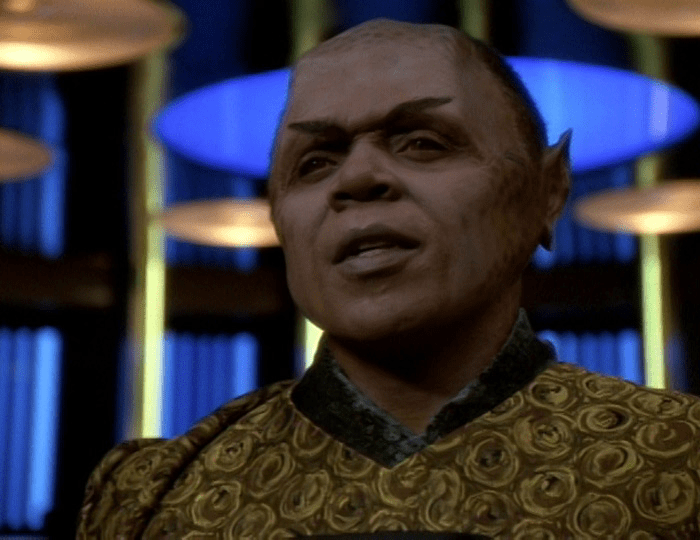
- “Drone” (Voyager, S5E2) — The Doctor’s mobile emitter fuses with Seven’s nanoprobes in a transporter malfunction, creating One: a 29th-century Borg drone who chooses to die rather than endanger the ship. The accident that created a person instead of destroying one.
- “Kayshon, His Eyes Open” (Lower Decks, S2E2) — A transporter duplicate creates William Boimler, in a deliberate homage to Thomas Riker. William later fakes his death and joins Section 31, because of course he does.
- “Twovix” (Lower Decks, S4E1) — The Tuvix scenario, plural. Multiple Cerritos crew members get merged into hybrid people (T’Ana + Billups = “T’Illups”), and the crew must confront the same ethical problem Janeway faced — this time played for horror and comedy.
- “A Level 5 Transporter Accident” (SNW, S4E5) — Scotty’s long-range transport experiment (test subject: his childhood puppet) rebounds onto the Enterprise, turning everyone but Spock into puppets. The episode that named the scale.
Level 6 — Serious injury
- “Strange New World” (Enterprise, S1E4) — Crewman Novakovich is beamed up through an electrical storm and materializes with leaves and twigs embedded in his skin. He survives (in the original script, he didn’t). A reminder that the NX-01’s transporter was rated for cargo.
(Note: I don’t remember this one at all. And eww.)
Level 7 — Universe breach
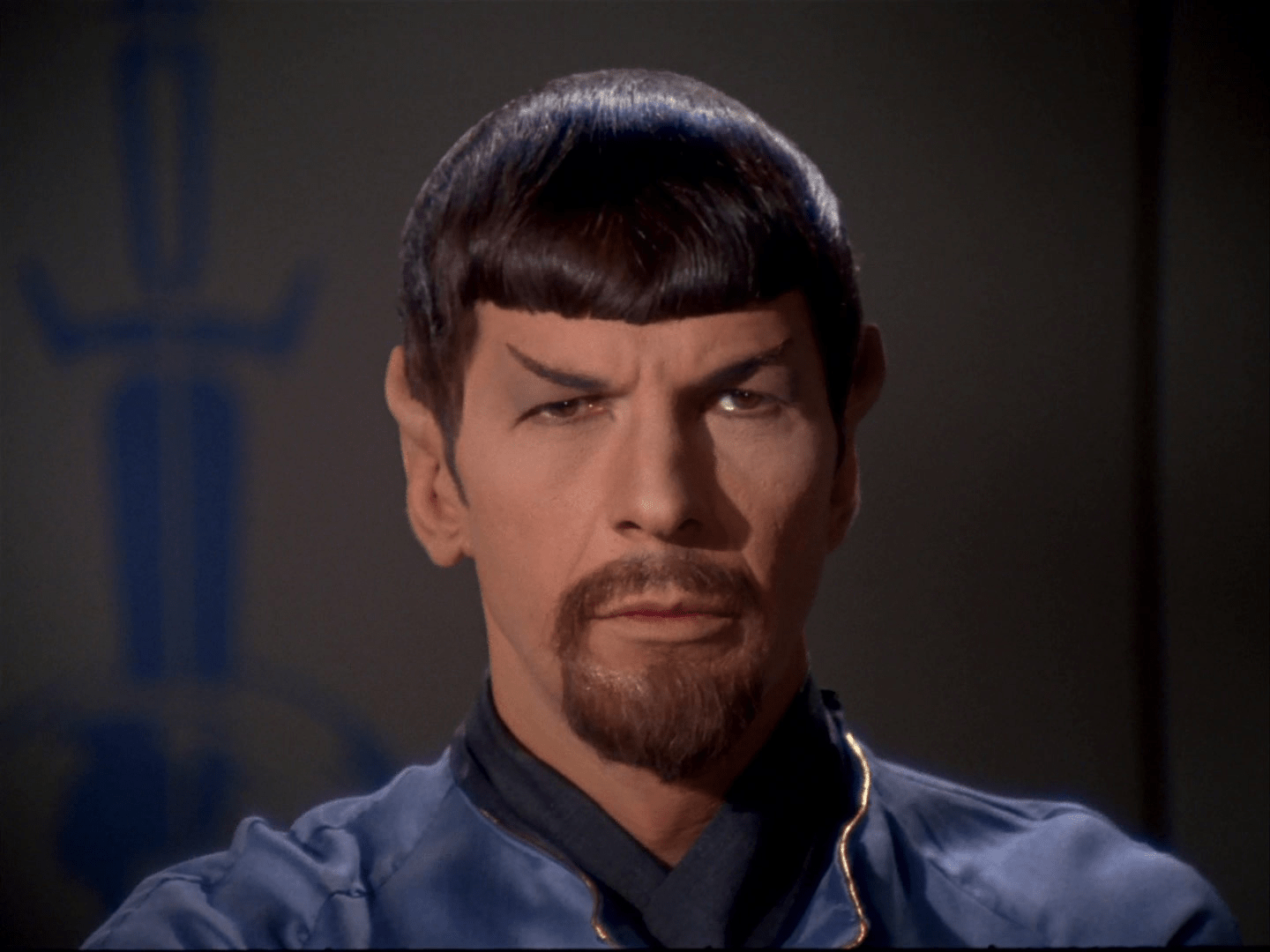
- “Mirror, Mirror” (TOS, S2E4) — An ion storm during transport swaps Kirk, Uhura, Scotty, and McCoy with their Terran Empire counterparts. Arguably a 5 by personal harm, but breaching the barrier between universes earns its own tier. Also responsible for fifty years of goatee jokes.
Level 8 — Fatality
- “Relics” (TNG, S6E4) — Scotty survives 75 years suspended in a pattern buffer through sheer engineering audacity. His crewmate Ensign Franklin’s pattern degrades past recovery. The buffer trick is legendary; the 50% survival rate is quietly devastating.
- “Daedalus” (Enterprise, S4E10) — Emory Erickson, inventor of the transporter, lost his son Quinn in an experimental “sub-quantum” test. Quinn drifts as a distorted energy pattern for years before being rematerialized — briefly, and fatally. The transporter’s creation myth comes with a body.
Level 9 — Multiple fatalities
- “And the Children Shall Lead” (TOS, S3E4) — Under the Gorgan’s influence, the Enterprise leaves orbit without anyone noticing, and two security officers are beamed down into open space. No sparkles, no rescue. Arguably operator error rather than malfunction, but the result speaks for itself.
(Note: I always hated that episode, and the “happy” ending occurs with a bunch of crying children. Yikes.)
Level 10 — Multiple fatalities, horrific
- Star Trek: The Motion Picture (1979) — A transporter malfunction mid-beam kills Commander Sonak and a second officer. We hear the screams through the comm as the patterns distort, followed by Starfleet’s report: “Enterprise, what we got back didn’t live long… fortunately.” The single most disturbing ninety seconds in the franchise, achieved almost entirely with sound design. The film never names the second victim; Roddenberry’s novelization identifies her as Vice Admiral Lori Ciana — and reveals she was Kirk’s former partner during his Admiralty years, turning an anonymous tragedy into a personal one the movie only hints at.
Edge Cases and Honorable Mentions
Deliberate misuse (not accidents, but worth an asterisk):
- “Wolf in the Fold” (TOS) — Redjac’s host is beamed out at maximum dispersal. Intentional, and honestly the most satisfying use of the “widest possible dispersal” setting in canon.
- “Faces” (Voyager) — The Vidiians deliberately split B’Elanna into a full Klingon and a full human. An Enemy Within scenario as a weapon.
- “The Darkness and the Light” (DS9) — A transporter used as a targeted assassination device.
- Picard, Season 3 — The largest transporter incident in canon, and no one noticed it happening. Changeling saboteurs modify the fleet’s transporters so every routine beam-out splices Borg-altered DNA into the traveler. Months later, on Frontier Day, every officer under 25 — thousands, fleet-wide — activates as a Borg drone. No storm, no malfunction: the technology working exactly as maliciously designed, which is somehow worse than any accident on this list.
(Note: I don’t remember any of that, but I’d pretty much completely checked out on ST:Picard by then anyway.) - Star Trek Into Darkness (2013) — Transwarp beaming: Scotty’s equation makes accidents obsolete by making the entire concept of “starships” briefly awkward.
The transporter as medicine (reverse accidents):
- “The Elysian Kingdom” (SNW, S1E8) — Dr. M’Benga keeps his daughter Rukiya suspended in the pattern buffer for months as medical stasis, pausing her terminal cygnokemia. Not an accident — the inverse. The longest successful intentional pattern-buffer suspension in canon, and the most flattering portrayal the transporter ever receives. (Scotty’s 75 years in “Relics” was longer, but involuntary — and with a 50% survival rate.)
- “Unnatural Selection” (TNG) — Pulaski’s hyper-aging cured by filtering her pattern through an earlier DNA sample.
(Note: So why doesn’t everybody keep a pattern of themselves in peak physical condition on file that they can reuse every decade or so? We probably shouldn’t ask.) - “The Lorelei Signal” and “The Terratin Incident” (TAS) — Stored patterns used to restore de-aged and shrunken crew, respectively. The animated series treated the pattern buffer as a full undo button.
Disputed classification:
- “Lonely Among Us” (TNG) — Picard beams out as pure energy and is restored from his stored pattern. Not exactly an accident; not exactly reassuring either.
- “Vanishing Point” (Enterprise) — Hoshi believes she’s fading out of existence post-transport. Nearly all of it happens in the 8.3 seconds she spends in the matter stream. Actual severity: Level 1. Perceived severity: Level 9.
- Star Trek (2009) — Amanda Grayson is lost when the ground collapses beneath her mid-lock. A targeting failure rather than a malfunction — the transporter did its job on a target that ceased to exist. The saddest entry in the “not technically an accident” file.
Sidebar: The Warranty Clause
Read the incident reports closely and a pattern emerges: the transporter almost never fails on its own. Nearly every entry in this catalog required conditions that any reasonable EULA would exclude:
| Incident | Warranty-voiding condition |
|---|---|
| The Enemy Within | Magnetic ore dust contaminating the pad (tracked in on a crewman’s uniform) |
| Mirror, Mirror | Beaming through an active ion storm |
| Realm of Fear | Plasma streamer distortion between two ships |
| Rascals | Molecular reversion field encountered mid-beam |
| Second Chances | Distortion field + an improvised second containment beam that reflected back |
| Past Tense | Chroniton particles from the Defiant’s cloaking device interacting with the beam |
| Tuvix | Alien orchid with symbiogenetic properties riding along in the matter stream |
| Drone | Emergency beam-out through a proto-nebula, damaging the Doctor’s mobile emitter |
| Strange New World (ENT) | Beaming through an electrical storm with a prototype rated barely above cargo |
| A Level 5 Transporter Accident | Experimental long-range transport protocol (test subject: puppet) |
| The Motion Picture | Refit hardware, not fully tested, pressed into service early |
Under normal operating conditions — routine beam-ups, calm space, production hardware — the transporter’s safety record is nearly spotless across thousands of uses per series. The accidents happen when someone beams through a storm, a field, a nebula, a cloaking device, or their own experimental protocol. The transporter isn’t dangerous; operating outside spec is dangerous, and Starfleet officers treat the recommended-conditions page the way developers treat documentation.
Which reframes McCoy and Barclay one more time: they weren’t afraid of the transporter. They were afraid of the people running it.
Sidebar: The Killing Machine Debate
Every catalog of transporter accidents eventually collides with the bigger question: is a successful transport just an accident with good PR?
The case for the prosecution is Derek Parfit’s teleporter problem in Starfleet uniform: the machine disassembles you, and something on the far pad believes it’s you. Thomas Riker is Exhibit A. If the process can yield two Rikers, then a “pattern” isn’t a person in transit — it’s a recipe being executed, and recipes can be run twice. At least one of the Rikers is a copy, and neither can tell you which.
The canon defense is the Ship of Theseus, with a warp coil bolted on. The transporter moves a matter stream — your actual atoms, converted to energy and reassembled — not a fax of your data. And here’s the thing: your body already runs this experiment continuously. Cells die and are replaced; molecules cycle through you constantly; the atoms that were “you” a decade ago are mostly somewhere else now. Nobody attends a funeral over cellular turnover. The transporter just compresses the plank-replacement schedule from years into seconds. If gradual replacement preserves the ship, it’s not obvious that speed is the thing that sinks it.
The strongest canonical evidence for the defense is, ironically, an entry in this catalog: “Realm of Fear.” Barclay is conscious inside the beam — looking around, reaching out, grabbing a trapped crewman by the arm. Continuity of experience, straight through the process. Hard to claim you died on the trip you remember taking.
But Thomas Riker sinks the matter-stream defense too. The second Riker’s atoms had to come from somewhere, and “the beam reflected off the distortion field” is doing a great deal of unpaid labor. The moment duplication is possible, the comfortable Theseus story — same planks, same ship — collapses back into the recipe problem.
Which leaves the franchise’s real running joke: its designated transporter skeptics are McCoy and Barclay, and the shows consistently frame them as cranks — while the writers keep accidentally generating evidence for their side. The pattern buffer is a backup drive. The matter stream is navigable. Duplication works. If a stored pattern is a recoverable person, then every beam-out is also a death you could restore from — which is either deeply reassuring or much, much worse, depending on which philosopher you beamed up with.
Closing Observation
By body count, The Motion Picture is the worst transporter accident in Star Trek history. But by philosophical weight, nothing touches Tuvix: it’s the only incident where the accident created something arguably better than what it destroyed, and the “repair” is the part fans are still arguing about thirty years later. The transporter’s real danger was never scrambled molecules — it’s that it forces the question of what a person actually is, and Starfleet has never once liked the answer.
Appendix: The Parody Canon
The transporter accident is so foundational a trope that the parodies have their own incident reports:
- Spaceballs (1987) — President Skroob, Level 4. An untested transporter run by the least competent crew in any galaxy delivers the President intact but assembled facing aft — head on backwards, granting him an unprecedented view of the presidential posterior (“Why didn’t somebody tell me my ass was so big?”). Significant transformation, fully reversed by running the transport again, and a flawless demonstration of the Warranty Clause: the hardware was fine; the operators were the malfunction.

- Galaxy Quest (1999) — the pig lizard, Level 8 (with the aesthetics of a 10). The digital conveyor’s first live test brings the creature aboard inside out, whereupon it explodes. Structurally, this is a beat-for-beat parody of The Motion Picture’s Level 10: the horror happens mostly out of frame, the aftermath is conveyed by horrified observers, and the scene lands on a clinical confirmation of the unspeakable — “Did you guys just hear that? The animal turned inside out… and then it exploded” is “what we got back didn’t live long… fortunately” played in a comedic key. Honorable footnote: the same conveyor worked flawlessly on humans later that day, making it the only transporter in any franchise whose safety record improved mid-crisis.
I did it too (a confession)
A personal disclosure: the SNW episode that inspired this catalog (Scotty conducting an unauthorized experimental long-range transport) was anticipated by thirty-five years. In October 1990, I wrote a TOS parody called “Star Trek: The (Intentionally?) Lost Episode” (printed in the November 1992 issue of Nimbus), and the resolution went like this:
“Captain, we have prepared the intermix process and connected the matter/antimatter propulsion units directly to the transporter circuits. At your command, we will engage the unit. If we are successful, the overall result will be to beam the entire ship back to Starbase 10.”
It works — on the third try, after the engines won’t turn over — and the Enterprise rematerializes a mere ten parsecs from its target. Graded on the scale above, beaming an entire starship across interstellar space using engines jump-started with an intermix formula “based on a theoretical relationship between time, space, and mind-altering chemicals” is the largest warranty violation in this entire catalog, and it rates a Level 1: everyone arrived intact. My Scotty had a better safety record than Paramount’s, and he was actively sobbing over his engines at the time.
In 1990 this was a joke. In 2026 it’s a plot summary. I had no idea.